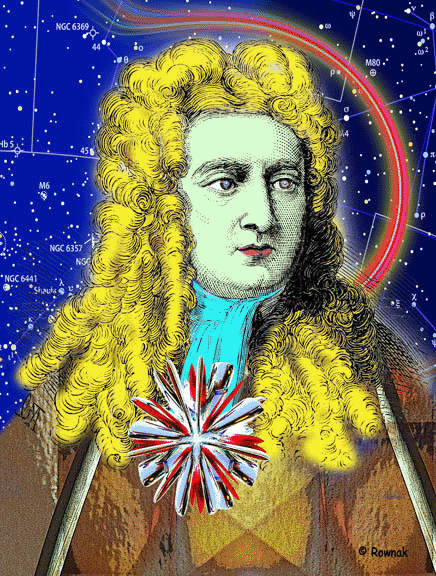
ISAAC
NEWTON
BIOGRAPHY
born in 1642 in a manor house in Lincolnshire, England.
His father had died two months before his birth. When Isaac was three
his mother remarried, and Isaac remained with his grandmother. He
was not interested in the family farm, so he was sent to Cambridge
University to study.
Isaac was born just a short time after the death of Galileo, one of
the greatest scientists of all time. Galileo had proved that the planets
revolve around the sun, not the earth as people thought at the time.
Isaac Newton was very interested in the discoveries of Galileo and
others. Isaac thought the universe worked like a machine and that
a few simple laws governed it. Like Galileo, he realized that mathematics
was the way to explain and prove those laws. Isaac Newton was one
of the world’s great scientists because he took his ideas, and
the ideas of earlier scientists, and combined them into a unified
picture of how the universe works.
Isaac Newton explained the workings of the universe through mathematics.
He formulated laws of motion and gravitation. These laws are math
formulas that explain how objects move when a force acts on them.
Isaac published his most famous book, Principia, in 1687 while he
was a mathematics professor at Trinity College, Cambridge. In the
Principia, Isaac explained three basic laws that govern the way objects
move. He then described his idea, or theory, about gravity. Gravity
is the force that causes things to fall down. If a pencil falls off
a desk, it will land on the floor, not the ceiling. In his book Isaac
also used his laws to show that the planets revolve around the suns
in orbits that are oval, not round.
Isaac
Newton used three laws to explain the way objects move. They are often
call Newton’s Laws. The First Law states that an object that
is not being pushed or pulled by some force will stay still, or will
keep moving in a straight line at a steady speed. It is easy to understand
that a bike will not move unless something pushes or pulls it. It
is harder to understand that an object will continue to move without
help. Think of the bike again. If someone is riding a bike and jumps
off before the bike is stopped what happens? The bike continues on
until it falls over. The tendency of an object to remain still, or
keep moving in a straight line at a steady speed is called inertia.
The
Second Law explains how a force acts on an object. An object accelerates
in the direction the force is moving it. If someone gets on a bike
and pushes the pedals forward the bike will begin to move. If someone
gives the bike a push from behind, the bike will speed up. If the
rider pushes back on the pedals the bike will slow down. If the rider
turns the handlebars, the bike will change direction.
The
Third Law states that if an object is pushed or pulled, it will push
or pull equally in the opposite direction. If someone lifts a heavy
box, they use force to push it up. The box is heavy because it is
producing an equal force downward on the lifter’s arms. The
weight is transferred through the lifter’s legs to the floor.
The floor presses upward with an equal force. If the floor pushed
back with less force, the person lifting the box would fall through
the floor. If it pushed back with more force the lifter would fly
into the air.
When
most people think of Isaac Newton, they think of him sitting under
an apple tree observing an apple fall to the ground. When he saw the
apple fall, Newton began to think about a specific kind of motion—gravity.
Newton understood that gravity was the force of attraction between
two objects. He also understood that an object with more matter –mass-
exerted the greater force, or pulled smaller object toward it. That
meant that the large mass of the earth pulled objects toward it. That
is why the apple fell down instead of up, and why people don’t
float in the air.
Isaac
Newton thought about gravity and the apple. He thought that maybe
gravity was not just limited to the earth and the objects on it. What
if gravity extended to the moon and beyond? Isaac calculated the force
needed to keep the moon moving around the earth. Then he compared
it with the force the made the apple fall downward. After allowing
for the fact that the moon is much farther from the earth, and has
a much greater mass, he discovered that the forces were the same.
The moon in held in an orbit around earth by the pull of earth’s
gravity.
Isaac
Newton’s calculations changed the way people understood the
universe. No one had been able to explain why the planets stayed in
their orbits. What held them up? Less that 50 years before Isaac Newton
was born it was thought that the planets were held in place by an
invisible shield. Isaac proved that they were held in place by the
sun’s gravity. He also showed that the force of gravity was
affected by distance and by mass. He was not the first to understand
that the orbit of a planet was not circular, but more elongated, like
an oval. What he did was to explain how it worked.
|
|