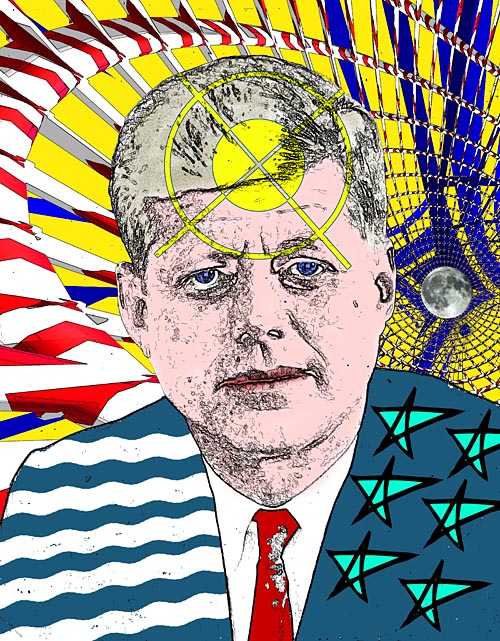
John Fitzgerald Kennedy ,
byname JFK
( 1917 – 1963 )
(born
May 29, 1917, Brookline, Massachusetts, U.S.—died November 22,
1963, Dallas, Texas) 35th president of the United States (1961–63),
who faced a number of foreign crises, especially in Cuba and Berlin,
but managed to secure such achievements as the Nuclear Test-Ban Treaty
and the Alliance for Progress. He was assassinated while riding in
a motorcade in Dallas.
Early
life
The second of nine children, Kennedy was reared in a family that demanded
intense physical and intellectual competition among the siblings—the
family's touch football games at their Hyannis Port retreat later
became legendary—and was schooled in the religious teachings
of the Roman Catholic church and the political precepts of the Democratic
Party. His father, Joseph Patrick Kennedy, had acquired a multimillion-dollar
fortune in banking, bootlegging, shipbuilding, and the film industry,
and as a skilled player of the stock market. His mother, Rose, was
the daughter of John F. (“Honey Fitz”) Fitzgerald, onetime
mayor of Boston. They established trust funds for their children that
guaranteed lifelong financial independence. After serving as the head
of the Securities and Exchange Commission, Joseph Kennedy became the
U.S. ambassador to Great Britain, and for six months in 1938 John
served as his secretary, drawing on that experience to write his senior
thesis at Harvard University (B.S., 1940) on Great Britain's military
unpreparedness. He then expanded that thesis into a best-selling book,
Why England Slept (1940).
In
the fall of 1941 Kennedy joined the U.S. Navy and two years later
was sent to the South Pacific. By the time he was discharged in 1945,
his older brother, Joe, who their father had expected would be the
first Kennedy to run for office, had been killed in the war, and the
family's political standard passed to John, who had planned to pursue
an academic or journalistic career.
John
Kennedy himself had barely escaped death in battle. Commanding a patrol
torpedo (PT) boat, he was gravely injured when a Japanese destroyer
sank it in the Solomon Islands. Marooned far behind enemy lines, he
led his men back to safety and was awarded the U.S. Navy and Marine
Corps Medal for heroism. He also returned to active command at his
own request. (These events were later depicted in a Hollywood film,
PT 109 [1963], that contributed to the Kennedy mystique.) However,
the further injury to his back, which had bothered him since his teens,
never really healed. Despite operations in 1944, 1954, and 1955, he
was in pain for much of the rest of his life. He also suffered from
Addison's disease, though this affliction was publicly concealed.
“At least one-half of the days he spent on this earth,”
wrote his brother Robert, “were days of intense physical pain.”
(After he became president, Kennedy combated the pain with injections
of amphetamines—then thought to be harmless and used by more
than a few celebrities for their energizing effect. According to some
reports, both Kennedy and the first lady became heavily dependent
on these injections through weekly use.) None of this prevented Kennedy
from undertaking a strenuous life in politics. His family expected
him to run for public office and to win.
Congressman
and senator
Kennedy did not disappoint his family; in fact, he never lost an election.
His first opportunity came in 1946, when he ran for Congress. Although
still physically weak from his war injuries, he campaigned aggressively,
bypassing the Democratic organization in the Massachusetts 11th congressional
district and depending instead upon his family, college friends, and
fellow navy officers. In the Democratic primary he received nearly
double the vote of his nearest opponent; in the November election
he overwhelmed the Republican candidate. He was only 29.
Kennedy
served three terms in the House of Representatives (1947–53)
as a bread-and-butter liberal. He advocated better working conditions,
more public housing, higher wages, lower prices, cheaper rents, and
more Social Security for the aged. In foreign policy he was an early
supporter of Cold War policies. He backed the Truman Doctrine and
the Marshall Plan but was sharply critical of the Truman administration's
record in Asia. He accused the State Department of trying to force
Chiang Kai-shek into a coalition with Mao Zedong. “What our
young men had saved,” he told the House on January 25, 1949,
“our diplomats and our President have frittered away.”
His
congressional district in Boston was a safe seat, but Kennedy was
too ambitious to remain long in the House of Representatives. In 1952
he ran for the U.S. Senate against the popular incumbent, Henry Cabot
Lodge, Jr. His mother and sisters Eunice, Patricia, and Jean held
“Kennedy teas” across the state. Thousands of volunteers
flocked to help, including his 27-year-old brother Robert, who managed
the campaign. That fall the Republican presidential candidate, General
Dwight D. Eisenhower, carried Massachusetts by 208,000 votes; but
Kennedy defeated Lodge by 70,000 votes. Less than a year later, on
September 12, 1953, Kennedy enhanced his electoral appeal by marrying
Jacqueline Lee Bouvier ( Jacqueline Kennedy Onassis). Twelve years
younger than Kennedy and from a socially prominent family, the beautiful
“Jackie” was the perfect complement to the handsome politician;
they made a glamorous couple.
As
a senator, Kennedy quickly won a reputation for responsiveness to
requests from constituents, except on certain occasions when the national
interest was at stake. In 1954 he was the only New England senator
to approve an extension of President Eisenhower's reciprocal-trade
powers, and he vigorously backed the opening of the St. Lawrence Seaway,
despite the fact that over a period of 20 years no Massachusetts senator
or congressman had ever voted for it.
To
the disappointment of liberal Democrats, Kennedy soft-pedaled the
demagogic excesses of Senator Joseph R. McCarthy of Wisconsin, who
in the early 1950s conducted witch-hunting campaigns against government
workers accused of being communists. Kennedy's father liked McCarthy,
contributed to his campaign, and even entertained him in the family's
compound at Hyannis Port on Cape Cod in Massachusetts. Kennedy himself
disapproved of McCarthy, but, as he once observed, “Half my
people in Massachusetts look on McCarthy as a hero.” Yet, on
the Senate vote over condemnation of McCarthy's conduct (1954), Kennedy
expected to vote against him. He prepared a speech explaining why,
but he was absent on the day of the vote. Later, at a National Press
Club Gridiron dinner, costumed reporters sang, “Where were you,
John, where were you, John, when the Senate censured Joe?” Actually,
John had been in a hospital, in critical condition after back surgery.
For six months afterward he lay strapped to a board in his father's
house in Palm Beach, Florida. It was during this period that he worked
on Profiles in Courage (1956), an account of eight great American
political leaders who had defied popular opinion in matters of conscience,
which was awarded a Pulitzer Prize in 1957. Although Kennedy was credited
as the book's author, it was later revealed that his assistant Theodore
Sorensen had done much of the research and writing.
Back in the Senate, Kennedy led a fight against a proposal to abolish
the electoral college, crusaded for labour reform, and became increasingly
committed to civil rights legislation. As a member of the Senate Committee
on Foreign Relations in the late 1950s, he advocated extensive foreign
aid to the emerging nations in Africa and Asia, and he surprised his
colleagues by calling upon France to grant Algerian independence.
During
these years his political outlook was moving leftward. Possibly because
of their father's dynamic personality, the sons of Joseph Kennedy
matured slowly. Gradually John's stature among Democrats grew, until
he had inherited the legions that had once followed Governor Adlai
E. Stevenson of Illinois, the two-time presidential candidate who
by appealing to idealism had transformed the Democratic Party and
made Kennedy's rise possible.
Presidential
candidate and president
Kennedy had nearly become Stevenson's vice presidential running mate
in 1956. The charismatic young New Englander's near victory and his
televised speech of concession (Estes Kefauver won the vice presidential
nomination) brought him into some 40 million American homes. Overnight
he had become one of the best-known political figures in the country.
Already his campaign for the 1960 nomination had begun. One newspaperman
called him a “young man in a hurry.” Kennedy felt that
he had to redouble his efforts because of the widespread conviction
that no Roman Catholic candidate could be elected president. He made
his 1958 race for reelection to the Senate a test of his popularity
in Massachusetts. His margin of victory was 874,608 votes—the
largest ever in Massachusetts politics and the greatest of any senatorial
candidate that year.
A
steady stream of speeches and periodical profiles followed, with photographs
of him and his wife appearing on many a magazine cover. Kennedy's
carefully calculated pursuit of the presidency years before the first
primary established a practice that became the norm for candidates
seeking the nation's highest office. To transport him and his staff
around the country, his father bought a 40-passenger Convair aircraft.
His brothers Robert (“Bobby,” or “Bob”) and
Edward (“Teddy,” or “Ted”) pitched in. After
having graduated from Harvard University (1948) and from the University
of Virginia Law School (1951), Bobby had embarked on a career as a
Justice Department attorney and counsellor for congressional committees.
Ted likewise had graduated from Harvard (1956) and from Virginia Law
School (1959). Both men were astute campaigners.
In
January 1960 John F. Kennedy formally announced his presidential candidacy.
His chief rivals were the senators Hubert H. Humphrey of Minnesota
and Lyndon B. Johnson of Texas. Kennedy knocked Humphrey out of the
campaign and dealt the religious taboo against Roman Catholics a blow
by winning the primary in Protestant West Virginia. He tackled the
Catholic issue again, by avowing his belief in the separation of church
and state in a televised speech before a group of Protestant ministers
in Houston, Texas. Nominated on the first ballot, he balanced the
Democratic ticket by choosing Johnson as his running mate. In his
acceptance speech Kennedy declared, “We stand on the edge of
a New Frontier.” Thereafter the phrase “New Frontier”
was associated with his presidential programs.
Another phrase—“the Kennedy style”—encapsulated
the candidate's emerging identity. It was glamorous and elitist, an
amalgam of his father's wealth, John Kennedy's charisma and easy wit,
Jacqueline Kennedy's beauty and fashion sense (the suits and pillbox
hats she wore became widely popular), the charm of their children
and relatives, and the erudition of the Harvard advisers who surrounded
him (called the “best and brightest” by author David Halberstam).
Kennedy
won the general election, narrowly defeating the Republican candidate,
Vice President Richard M. Nixon, by a margin of less than 120,000
out of some 70,000,000 votes cast. Many observers, then and since,
believed vote fraud contributed to Kennedy's victory, especially in
the critical state of Illinois, where Joe Kennedy enlisted the help
of the ever-powerful Richard J. Daley, mayor of Chicago. Nixon had
defended the Eisenhower record; Kennedy, whose slogan had been “Let's
get this country moving again,” had deplored unemployment, the
sluggish economy, the so-called missile gap (a presumed Soviet superiority
over the United States in the number of nuclear-armed missiles), and
the new communist government in Havana. A major factor in the campaign
was a unique series of four televised debates between the two men;
an estimated 85–120 million Americans watched one or more of
the debates. Both men showed a firm grasp of the issues, but Kennedy's
poise in front of the camera, his tony Harvard accent, and his good
looks (in contrast to Nixon's “five o'clock shadow”) convinced
many viewers that he had won the debate. As president, Kennedy continued
to exploit the new medium, sparkling in precedent-setting televised
weekly press conferences.
He
was the youngest man and the first Roman Catholic ever elected to
the presidency of the United States. His administration lasted 1,037
days. From the onset he was concerned with foreign affairs. In his
memorable inaugural address ( original text), he called upon Americans
“to bear the burden of a long twilight struggle…against
the common enemies of man: tyranny, poverty, disease, and war itself.”
( primary source document: A Long Twilight Struggle.) He declared:
In
the long history of the world, only a few generations have been granted
the role of defending freedom in its hour of maximum danger. I do
not shrink from this responsibility—I welcome it.…The
energy, the faith, the devotion which we bring to this endeavor will
light our country and all who serve it—and the glow from that
fire can truly light the world. And so, my fellow Americans: ask not
what your country can do for you—ask what you can do for your
country.
The
administration's first brush with foreign affairs was a disaster.
In the last year of the Eisenhower presidency, the Central Intelligence
Agency (CIA) had equipped and trained a brigade of anticommunist Cuban
exiles for an invasion of their homeland. The Joint Chiefs of Staff
unanimously advised the new president that this force, once ashore,
would spark a general uprising against the Cuban leader, Fidel Castro.
But the Bay of Pigs invasion was a fiasco; every man on the beachhead
was either killed or captured. Kennedy assumed “sole responsibility”
for the setback. Privately he told his father that he would never
again accept a Joint Chiefs recommendation without first challenging
it.
The
Soviet premier, Nikita Khrushchev, thought he had taken the young
president's measure when the two leaders met in Vienna in June 1961.
Khrushchev ordered a wall built between East and West Berlin and threatened
to sign a separate peace treaty with East Germany. The president activated
National Guard and reserve units, and Khrushchev backed down on his
separate peace threat. Kennedy then made a dramatic visit to West
Berlin, where he told a cheering crowd, “Today, in the world
of freedom, the proudest boast is ‘Ich bin ein [I am a] Berliner.'
” In October 1962 a buildup of Soviet short- and intermediate-range
nuclear missiles was discovered in Cuba. Kennedy demanded that the
missiles be dismantled; he ordered a “quarantine” of Cuba
( original text)—in effect, a blockade that would stop Soviet
ships from reaching that island. For 13 days nuclear war seemed near;
then the Soviet premier announced that the offensive weapons would
be withdrawn. ( Cuban missile crisis.) Ten months later Kennedy scored
his greatest foreign triumph when Khrushchev and Prime Minister Harold
Macmillan of Great Britain joined him in signing the Nuclear Test-Ban
Treaty. Yet Kennedy's commitment to combat the spread of communism
led him to escalate American involvement in the conflict in Vietnam,
where he sent not just supplies and financial assistance, as President
Eisenhower had, but 15,000 military advisers as well.
Because
of his slender victory in 1960, Kennedy approached Congress warily,
and with good reason; Congress was largely indifferent to his legislative
program. It approved his Alliance for Progress (Alianza) in Latin
America and his Peace Corps, which won the enthusiastic endorsement
of thousands of college students. But his two most cherished projects,
massive income tax cuts and a sweeping civil rights measure, were
not passed until after his death. ( primary source document: The American
Promise to African Americans.) In May 1961 Kennedy committed the United
States to land a man on the Moon by the end of the decade, and, while
he would not live to see this achievement either, his advocacy of
the space program contributed to the successful launch of the first
American manned spaceflights.
He was an immensely popular president, at home and abroad. At times
he seemed to be everywhere at once, encouraging better physical fitness,
improving the morale of government workers, bringing brilliant advisers
to the White House, and beautifying Washington, D.C. His wife joined
him as an advocate for American culture. Their two young children,
Caroline Bouvier and John F., Jr., were familiar throughout the country.
The charm and optimism of the Kennedy family seemed contagious, sparking
the idealism of a generation for whom the Kennedy White House became,
in journalist Theodore White's famous analogy, Camelot—the magical
court of Arthurian legend, which was celebrated in a popular Broadway
musical of the early 1960s.
Joseph
Kennedy, meanwhile, had been incapacitated in Hyannis Port by a stroke,
but the other Kennedys were in and out of Washington. Robert Kennedy,
as John's attorney general, was the second most powerful man in the
country. He advised the president on all matters of foreign and domestic
policy, national security, and political affairs.
In
1962 Ted Kennedy was elected to the president's former Senate seat
in Massachusetts. Their sister Eunice's husband, Sargent Shriver,
became director of the Peace Corps. Their sister Jean's husband, Stephen
Smith, was preparing to manage the Democratic Party's 1964 presidential
campaign. Another sister, Patricia, had married Peter Lawford, an
English-born actor who served the family as an unofficial envoy to
the entertainment world. All Americans knew who Rose, Jackie, Bobby,
and Teddy were, and most could identify Bobby's wife as Ethel and
Teddy's wife as Joan. But if the first family had become American
royalty, its image of perfection would be tainted years later by allegations
of marital infidelity by the president (most notably, an affair with
motion-picture icon Marilyn Monroe) and of his association with members
of organized crime.
Assassination
President Kennedy believed that his Republican opponent in 1964 would
be Senator Barry Goldwater of Arizona. He was convinced that he could
bury Goldwater under an avalanche of votes, thus receiving a mandate
for major legislative reforms. One obstacle to his plan was a feud
in Vice President Johnson's home state of Texas between Governor John
B. Connally, Jr., and Senator Ralph Yarborough, both Democrats. To
present a show of unity, the president decided to tour the state with
both men. On Friday, November 22, 1963, he and Jacqueline Kennedy
were in an open limousine riding slowly in a motorcade through downtown
Dallas. At 12:30 the president was struck by two rifle bullets, one
at the base of his neck and one in the head. He was pronounced dead
shortly after arrival at Parkland Memorial Hospital. Governor Connally,
though also gravely wounded, recovered. Vice President Johnson took
the oath as president at 2:38 . Lee Harvey Oswald, a 24-year-old Dallas
citizen, was accused of the slaying. Two days later Oswald was shot
to death by Jack Ruby, a local nightclub owner with connections to
the criminal underworld, in the basement of a Dallas police station.
A presidential commission headed by the chief justice of the United
States, Earl Warren, later found that neither the sniper nor his killer
“was part of any conspiracy, domestic or foreign, to assassinate
President Kennedy,” but that Oswald had acted alone. The Warren
Commission, however, was not able to convincingly explain all the
particular circumstances of Kennedy's murder. In 1979 a special committee
of the U.S. House of Representatives declared that although the president
had undoubtedly been slain by Oswald, acoustic analysis suggested
the presence of a second gunman who had missed. But this declaration
did little to squelch the theories that Oswald was part of a conspiracy
involving either CIA agents angered over Kennedy's handling of the
Bay of Pigs fiasco or members of organized crime seeking revenge for
Attorney General Bobby Kennedy's relentless criminal investigations.
Kennedy's assassination, the most notorious political murder of the
20th century, remains a source of bafflement, controversy, and speculation.
John
Kennedy was dead, but the Kennedy mystique was still alive. Both Robert
and Ted ran for president (in 1968 and 1980, respectively). Yet tragedy
would become nearly synonymous with the Kennedys when Bobby, too,
was assassinated on the campaign trail in 1968.
Jacqueline
Kennedy and her two children moved from the White House to a home
in the Georgetown section of Washington. Continuing crowds of the
worshipful and curious made peace there impossible, however, and in
the summer of 1964 she moved to New York City. Pursuit continued until
October 20, 1968, when she married Aristotle Onassis, a wealthy Greek
shipping magnate. The Associated Press said that the marriage “broke
the spell of almost complete adulation of a woman who had become virtually
a legend in her own time.” Widowed by Onassis, the former first
lady returned to the public eye in the mid-1970s as a high-profile
book editor, and she remained among the most admired women in the
United States until her death in 1994. As an adult, daughter Caroline
was jealous of her own privacy, but John Jr.—a lawyer like his
sister and debonair and handsome like his father—was much more
of a public figure. Long remembered as “John-John,” the
three-year-old who stoically saluted his father's casket during live
television coverage of the funeral procession, John Jr. became the
founder and editor-in-chief of the political magazine George in the
mid-1990s. In 1999, when John Jr., his wife, and his sister-in-law
died in the crash of the private plane he was piloting, the event
was the focus of an international media watch that further proved
the immortality of the Kennedy mystique. It was yet another chapter
in the family's “curse” of tragedy.
-
William Manchester
http://www.biography.com/articles/John-Fitzgerald-Kennedy-9362930
|