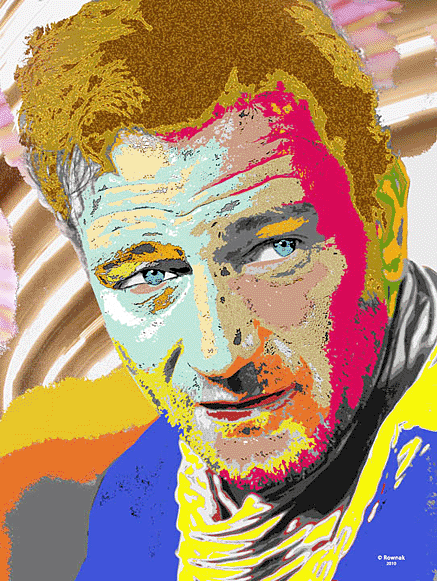
John Wayne Biography
originally Marion Morrison, nicknamed "Duke"
( 1907 – 1979 )
Actor. Born Marion Robert Morrison on May 26,
1907, in Winterset, Iowa. (Some sources also list him as Marion Michael
Morrison and Marion Mitchell Morrison.) One of the most popular film
actors of the twentieth century, John Wayne remains a popular American
icon to this day. He was already a sizable presence when he was born,
weighing around 13 pounds.
The
oldest of two children born to Clyde and Mary "Molly" Morrison,
Wayne moved to Lancester, California, around the age of seven. The
family moved again a few years later after Clyde failed in his attempt
to become a farmer.
Settling
in Glendale, California, Wayne received his distinctive nickname "Duke"
while living there. He had a dog by that name, and he spent so much
time with his pet that the pair became known as "Little Duke"
and "Big Duke," according to the official John Wayne website.
In high school, Wayne excelled in his classes and in many different
activities, including student government and football. He also participated
in numerous student theatrical productions.
Winning
a football scholarship to University of Southern California (USC),
Wayne started college in the fall of 1925. He joined the Sigma Chi
fraternity and continued to be a strong student. Unfortunately, after
two years, an injury took him off the football field and ended his
scholarship. While in college, Wayne had done some work as a film
extra, appearing as a football player in Brown of Harvard (1926) and
Drop Kick (1927).
Out
of school, Wayne worked as an extra and a prop man in the film industry.
He first met director John Ford while working as an extra on Mother
Machree (1928). With The Big Trail (1930), Wayne received his first
leading role, thanks to director Raoul Walsh. Walsh is often credited
with helping him create his now legendary screen name, John Wayne.
Unfortunately, the western was a box office dud.
For
nearly a decade, Wayne toiled in numerous B movies�mostly westerns�for
different studios. He even played a singing cowboy named Sandy Saunders
among his many roles. During this time period, however, Wayne started
developing his man of action persona, which would serve as the basis
of many popular characters later on.
Working
with Ford, he got his next big break in Stagecoach (1939). Wayne portrayed
the Ringo Kid, an escaped outlaw, who joins an unusual assortment
of characters on a dangerous journey through frontier lands. During
the trip, the Kid falls for a dance hall prostitute named Dallas (Claire
Trevor). The film was well received by movie goers and critics alike
and earned seven Academy Award nominations, including one for Ford's
direction. In the end, it took home the awards for Music and for Actor
in a Supporting Role for Thomas Mitchell.
Reunited
with Ford and Mitchell, Wayne stepped away from his usual Western
roles to become a Swedish seaman in The Long Voyage Home (1940). The
film was adapted from a play by Eugene O'Neill and follows the crew
of a steamer ship as they move a shipment of explosives. Along with
many positive reviews, the movie earned several Academy Award nominations.
Around this time, Wayne made the first of several movies with German
actress and famous sex symbol Marlene Dietrich. The two appeared together
in Seven Sinners (1940) with Wayne playing a naval officer and Dietrich
as a woman who sets out to seduce him. Off-screen, they became romantically
involved, though Wayne was married at the time. There had been rumors
about Wayne having other affairs, but nothing as substantial as his
connection to Dietrich. Even after their physical relationship ended,
the pair remained good friends and co-starred in two more films, Pittsburgh
(1942) and The Spoilers (1942).
Wayne
started working behind the scenes as a producer in the late 1940s.
The first film he produced was Angel and the Badman (1947). Over the
years, he operated several different production companies, including
John Wayne Productions, Wayne-Fellows Productions, and Batjac Productions.
Wayne's
career as an actor took another leap forward when he worked with director
Howard Hawks in Red River (1948). The western drama provided Wayne
with an opportunity to show his talents as an actor, not just an action
hero. Playing the conflicted cattleman Tom Dunson, he took on a darker
sort of character. He deftly handled his character's slow collapse
and difficult relationship with his adopted son played by Montgomery
Clift. Also around this time, Wayne also received praise for his work
in John Ford's Fort Apache (1948) with Henry Fonda and Shirley Temple.
Taking
on a war drama, Wayne gave a strong performance in Sands of Iwo Jima
(1949), which garnered him his first Academy Award nomination for
Best Actor. He also appeared in more two westerns by Ford now considered
classics: She Wore a Yellow Ribbon (1949) and Rio Grande (1950) with
Maureen O'Hara.
Wayne
worked with O'Hara on several films, perhaps most notably The Quiet
Man (1952). Playing an American boxer with a bad reputation, his character
moved to Ireland where he fell in love with a local woman (Maureen
O'Hara). This film is considered Wayne's most convincing leading romantic
role by many critics.
A
well-known conservative and anticommunist, Wayne merged his personal
beliefs and his professional life in 1952's Big Jim McLain. He played
an investigator working for the U.S. House Un-American Activities
Committee, which worked to root out communists in all aspects of public
life. Off screen, Wayne played a leading role in the Motion Picture
Alliance for the Preservation of American Ideals and even served as
its president for a time. The organization was a group of conservatives
who wanted to stop communists from working in the film industry, and
other members included Gary Cooper and Ronald Reagan.
In
1956, Wayne starred in another Ford western, The Searchers, and again
showed some dramatic range as the morally questionable Civil War veteran
Ethan Edwards. He soon after reteamed with Howard Hawks for Rio Bravo
(1959). Playing a local sheriff, Wayne's character must face off against
a powerful rancher and his henchmen who want to free his jailed brother.
The unusual cast included Dean Martin and Angie Dickinson.
Wayne made his directorial debut with The Alamo (1960). Starring in
the film as Davy Crockett, he received decidedly mixed reviews for
both his on- and off-screen efforts. Wayne received a much warmer
reception for The Man Who Shot Liberty Valance (1962) with Jimmy Stewart
and Lee Marvin and directed by John Ford. Some other notable films
from this period include The Longest Day (1962) and How the West Was
Won (1962). Continuing to work steadily, Wayne refused to even let
illness slow him down. He successfully battled lung cancer in 1964.
To defeat the disease, Wayne had to have a lung and several ribs removed.
In
the later part of the 1960s, Wayne had some great successes and failures.
He co-starred with Robert Mitchum in El Dorado (1967), which was well
received. The next year, Wayne again mixed the professional and the
political with the pro-Vietnam War film The Green Berets (1968). He
directed and produced as well as starred in the film, which was derided
by critics for being heavy handed and clichéd. Viewed by many
as a piece of propaganda, the film still did well at the box office.
Around
this time, Wayne continued to espouse his conservative political views.
He support friend Ronald Reagan in his 1966 bid for governor of California
as well as his 1970 re-election effort. In 1976, Wayne recorded radio
advertisements for Reagan's first attempt to become the Republican
presidential candidate.
Wayne
won his first Academy Award for Best Actor for True Grit (1969). He
played Rooster Cogburn, an eye-patching drunkard and lawman, who helps
a young woman named Mattie (Kim Darby) track down her father's killer.
A young Glen Campbell joined the pair on their mission. Rounding out
the cast, Robert Duvall and Dennis Hopper were among the bad guys
the trio had to defeat. A later sequel with Katherine Hepburn, Rooster
Cogburn (1975), failed to attract critical acclaim or much of an audience.
Wayne
portrayed an aging gunfighter dying of cancer in his final film, The
Shootist (1976), with Jimmy Stewart and Lauren Bacall. His character,
John Bernard Books, hoped to spend his final days peacefully, but
got involved one last gunfight. In 1978, life imitated art with Wayne
being diagnosed with stomach cancer.
Wayne
died on June 11, 1979, in Los Angeles, California. He was survived
by his seven children from two of his three marriages. During his
marriage to Josephine Saenz from 1933 to 1945, the couple had four
children, two daughters Antonia and Melinda and two sons Michael and
Patrick. Both Michael and Patrick followed in their father's footsteps.
Michael as a producer and Patrick as an actor. With his third wife,
Pilar Palette, he had three more children, Ethan, Aissa, and Marisa.
Ethan has worked as an actor over the years.
Shortly
before his death, the U.S. Congress approved a congressional gold
medal for Wayne. It was given to his family in 1980. In the same month
as the Duke's passing, the Orange County Airport was renamed after
him. He was later featured on a postage stamp in 1990 and again in
2004 and was inducted into the California Hall of Fame in 2007.
In
honor of his charitable work in the fight against cancer, Wayne's
children established the John Wayne Cancer Foundation in 1985. The
organization provides support to numerous cancer-related programs
and to the John Wayne Cancer Institute at Saint John's Health Center
in Santa Monica, California.
©
2010 A&E Television Networks. All rights reserved.
|